Euler Partners

Making sense
of AI-driven complexity.

Guiding boards and leadership teams through AI adoption, agentic governance, and adaptive organisational design.

Email us

Our radically changing world
demands a radically different ability
to explore, discover, and adapt.

Our Services

Making consequential AI decisions

AI deployment in uncertain, complex environments.

When markets were complicated, expert analysis could map cause and effect and define a plan. In complex environments, cause and effect become visible only in retrospect — the technology moves faster than planning cycles can absorb.

  • Executive masterclasses and board coaching
  • Embedded in your team to design and execute defined safe-to-fail experiments
  • Live measurement of AI model behaviour and experiment outcomes
  • Explicit scale-or-retire criteria, agreed before the experiments start
  • Your team running the process without us

Agentic Governance & Operating Design

Bridging the gap between intent and execution.

Leaders need to evidence and steer AI activity — its potential value and its risks — in language the boardroom can understand and act on. We design measurement and governance frameworks drawing directly on scorecarding and stakeholder governance experience: indicators that show direction and momentum rather than static targets, and reporting that answers the questions the board is actually asking.

  • Executive masterclasses and board coaching
  • AI inventory, assessment, and compliance
  • Governance framework, scorecard and reporting cadence
  • Decision rights embedded in workflows, where humans sit in agentic loops
  • Implementation design

The Organisation as Organism

From mechanistic processes to adaptive, resilient systems.

Traditional frameworks treat organisations like machines. But when technology and markets shift faster than annual or quarterly cycles, the organisations that endure look more like living systems — sensing, learning, adapting. This is not a metaphor. It is a practice rooted in complexity science and biology.

We advise leadership teams on what this looks like in practice — how to structure and lead an organisation built to adapt.

  • Executive masterclasses and board coaching
  • Understanding the implications for org design
  • Influence Scorecard
  • Wardley mapping

Guiding AI's human and organisational impact

Accountability, culture, and change for AI adoption.

Governance: mapping accountability where algorithmic systems make responsibility difficult to trace, aligned with internal policy.

Culture: assessing how the organisation actually works — whether it is safe to experiment, how performance is managed, whether incentives support the intended change.

Change and engagement: plans that carry the transformation, and structured stakeholder dialogue that is transparent and informs decision-making.

  • Role and accountability map; internal policy alignment
  • Culture assessment
  • Change and adoption plan; messaging aligned with strategy
  • Stakeholder accountability map
  • Engagement framework

Who We Are

Decades of experience in consulting, strategy and technology leadership. Our core team is complemented by a network of collaborators as needed — engineers, researchers, and change consultants.

Philip Sheldrake CEng

Technologist, digital innovator, consultant, and researcher spanning AI, Web3, and identity

Philip Sheldrake

Philip works at the intersection of human systems and technological innovation. Most recently, he's been working with a team of software architects and engineers, developing the concept and realisation of supersoftware — software that is itself symbolic AI — for unparalleled neurosymbolic integration with LLMs.

Clients range from a flagship airline and multi-$bn growth equity fund, to SMEs and embryonic technical protocols. He contributed to the Ethereum Foundation’s early organisational deliberations, and worked alongside an Ethereum co-founder on questions of decentralised social and decentralised organising. His design for a systemic intervention in the agri-food sector is adopted by the UN Environment Programme's Good Food Finance Network.

Philip is frequently invited to bring a fresh perspective to complex domains: an invitation to critique a chapter of Radical Markets by its author Glen Weyl; presenting alongside Vitalik Buterin and Professors Margaret Levi and Bryan Ford on the complexities of online democracy; contributing to Dutch government policy on European digital identity.

Proud moment — chairing a conversation with Sir Tim Berners-Lee at the Royal Society.

Jay O'Connor PhD

Stakeholder engagement, change, governance and accountability

Jay O'Connor

Jay is an advisor to boards and leadership teams on change, transformation and stakeholder engagement — supporting organisations with the communication, culture and adoption work that transformations need to succeed.

Her practice draws on twenty years advising boards and chief executives, and roles as chair, executive director and trustee, including leadership of a European public relations consultancy and the Chartered Institute of Public Relations. It's grounded in a doctorate focused on governance and accountability, which informs the accountability dimension of the advisory work — how organisations remain answerable for decisions made in complex conditions.

Affiliations: International Advisory Board Member, Open University Faculty of Business and Law; International Fellow, Chartered Director, and Associate of the Centre for Corporate Governance at the Institute of Directors; former Managing Director, European Operations, and Past President of the Chartered Institute of Public Relations.

Jay's experience spans global businesses, scale-ups, research institutions and non-profits in sectors including technology, manufacturing, healthcare and higher education.

Practice & Proof

What we do, and what we can point to: research, books, platforms, accreditation.

The Business of Influence / thought leadership

Thought leadership

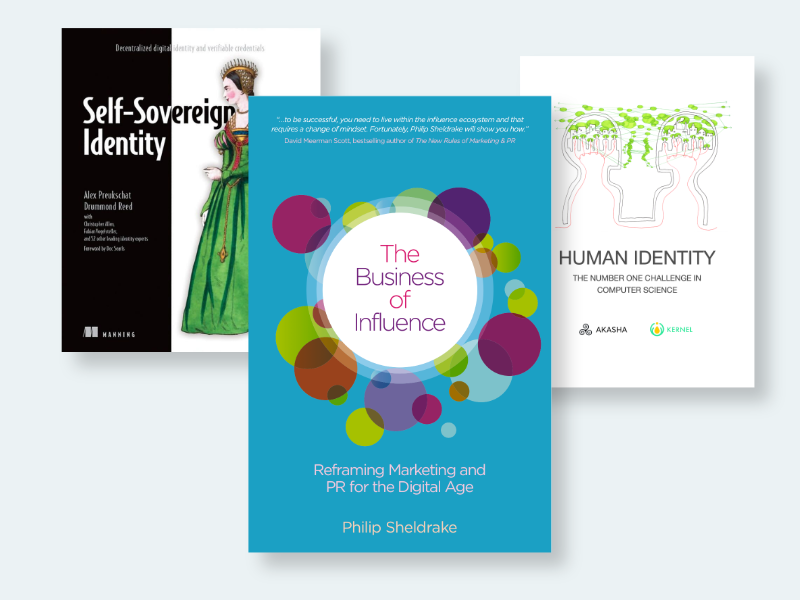
The Business of Influence (Wiley) redraws the enterprise as a network of influence flows rather than functional silos, helping leaders see the organisation as adaptive organism. The argument is summarised in the Balanced Scorecard Report (Harvard Business Publishing). Later work carries the thinking into digital identity: Human Identity, and the contribution to the SSI book, argue that questions of identity design are, in practice, questions of organisational design.

Abstract image / speech waves

Speaking

On the organisational application of technology — Dreamforce, 3M, Ethereum, Edge City, No. 10 Downing Street, Oxford University.

Arrange a conversation